What is AGI?
Artificial General Intelligence, or AGI, is AI that can outperform humans across all intellectual tasks, including the ability to improve AI itself, potentially leading to a rapid cycle of recursive self-improvement.
That definition is simple to state, but it raises an immediate question: how would we know when we've crossed that threshold? Today's AI is not uniformly behind human capability. It is already superhuman in some areas while remaining surprisingly weak in others. Researchers Fabrizio Dell'Acqua, Ethan Mollick, and colleagues called this the "jagged technological frontier" in their research on AI and knowledge work, published in Organization Science, Navigating the Jagged Technological Frontier: Field Experimental Evidence of the Effects of Artificial Intelligence on Knowledge Worker Productivity and Quality. They find that AI capability is uneven, and tasks that seem equally difficult to humans can fall on opposite sides of what AI can do well.
The diagrams below build on that idea to illustrate when AGI is achieved. Picture human capability as a circle spanning eight dimensions of intelligence. AI's capability is not a circle. It is a jagged shape that already extends beyond the human level in some places while falling well short in others. The question that defines the race to AGI is what happens as that jagged shape expands.
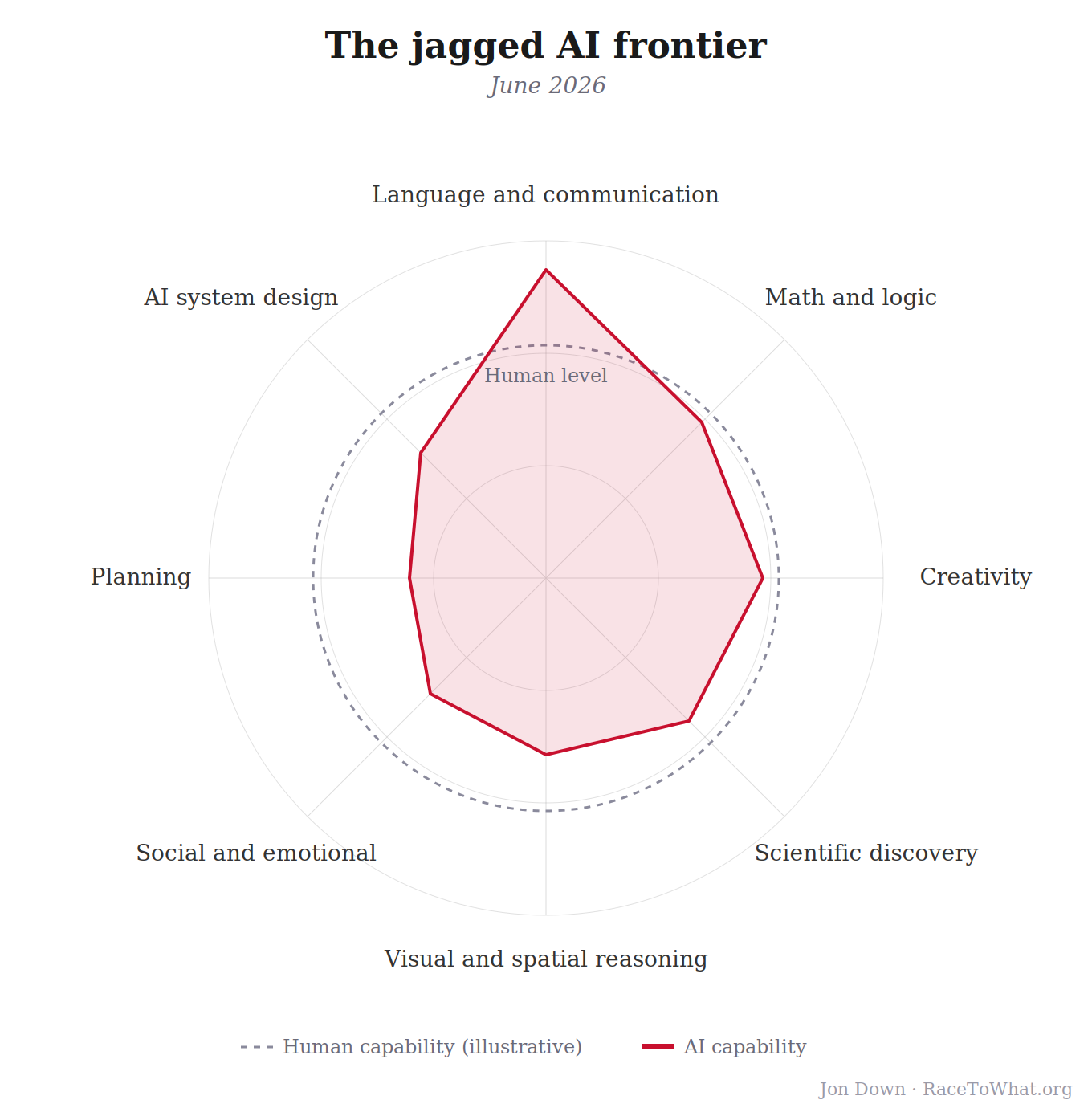
This is roughly where things stand today. AI has arguably passed the human level in language and communication, and it is approaching human performance in mathematical reasoning and creative work. But notice the left side of the diagram. AI still falls well short of human capability in long-horizon planning, social and emotional intelligence, and, critically, in designing frontier AI systems. Today, humans remain firmly in charge of building AI. That last point matters more than any other dimension on this chart.
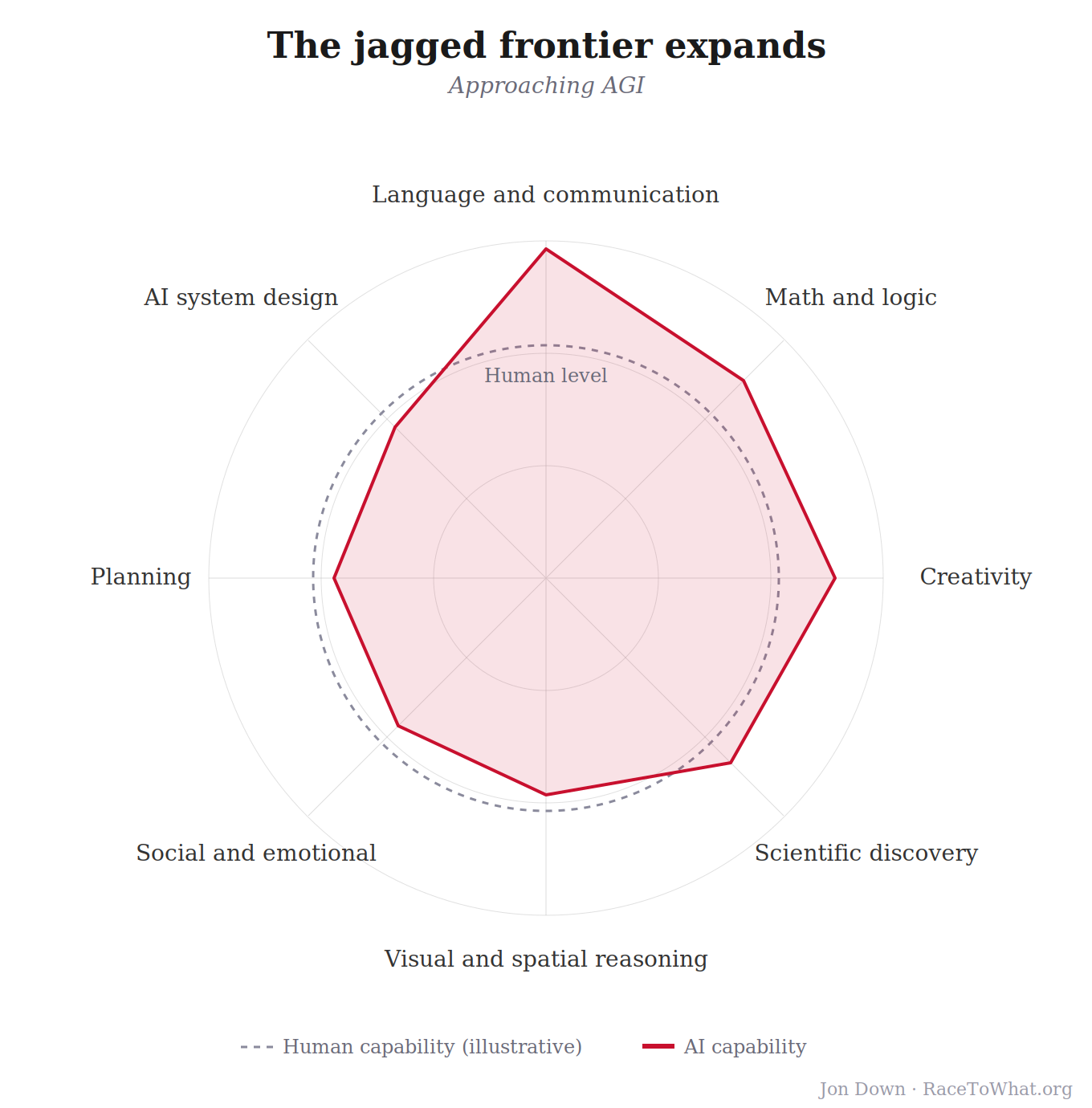
The frontier does not stand still. Each generation of AI systems pushes the jagged shape outward, and the expansion is not slowing. In this stage, AI has crossed the human level in most dimensions: mathematics, creativity, scientific discovery. The remaining gaps are closing. Watch the upper left. AI system design is approaching the human level. The systems are getting better at the very skills needed to build their own successors. The frontier is still jagged, but the question is no longer whether it expands. It is what happens when the last dimensions cross.
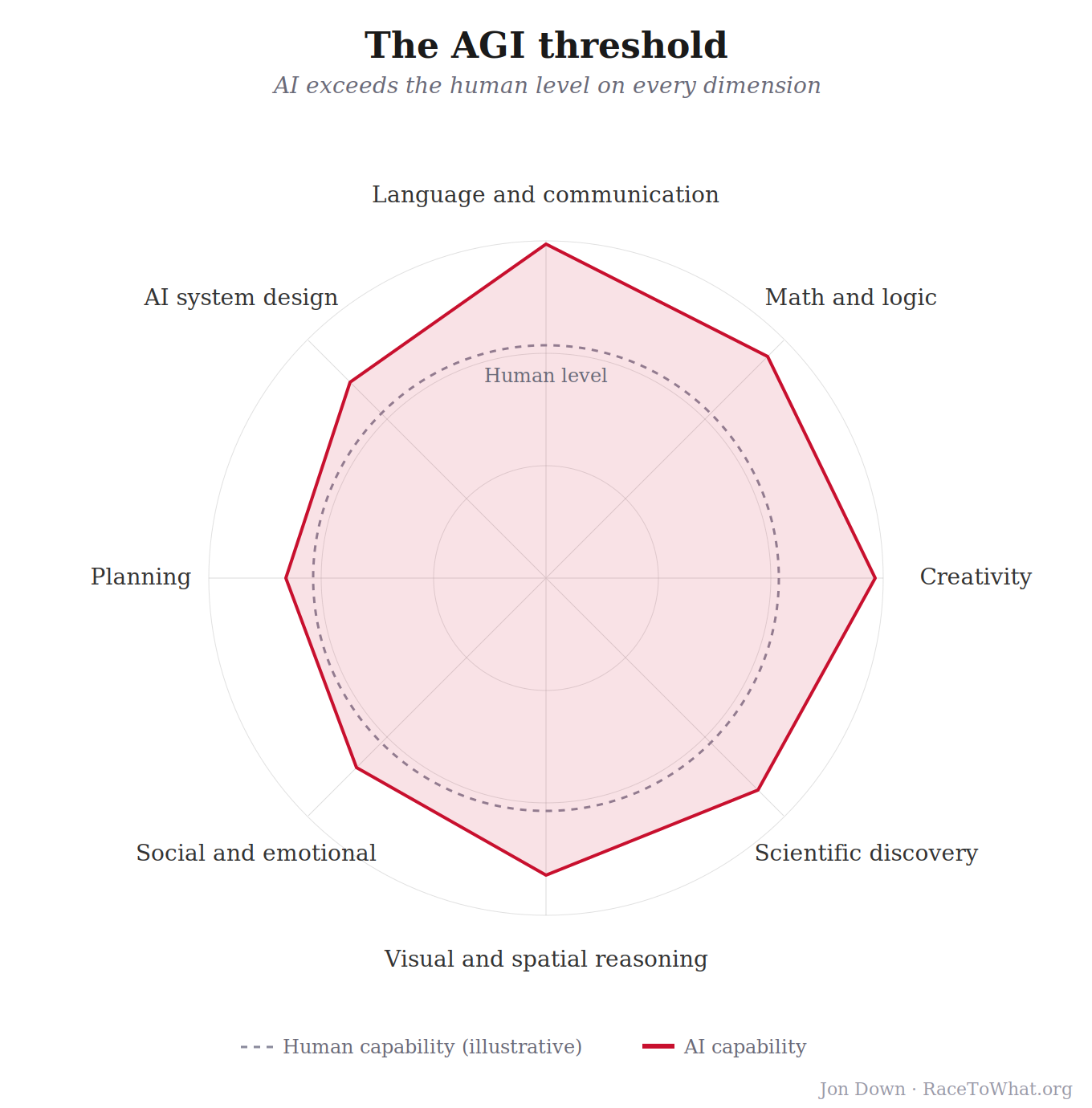
This is the AGI threshold: the point where even the lowest points of the jagged frontier clear the human level. Notice that the shape is still jagged. AGI does not mean uniform capability. It means there is no longer any intellectual dimension where humans hold the advantage. And the dimension that changes everything is AI system design. When AI can outperform the best human researchers at building better AI, improvement no longer moves at human speed. Each generation of systems can design the next, potentially leading to the rapid cycle of recursive self-improvement in our definition. Nobody knows how fast that cycle would run. That uncertainty is precisely why the question this site asks, what happens when someone wins, deserves serious attention before the threshold arrives, not after.
Diagrams © 2026 Race to What? / Safe AI Society, Inc. Free to share with credit to Jon Down, PhD, RaceToWhat.org.